


 0
0
From May 23 to 26, the Circuit de Monaco will host the 6th race of the 2019 World Formula 1 Championship. The track that winds through the streets of the principality of Monaco has hosted the most advanced single-seaters in the world without interruption since 1955, although the first Formula 1 GP was held here in 1950.
The proximity of the Armco barriers mandates that drivers perform with utmost precision: braking incorrectly, even by just one yard, could result in crashing into the guardrail and withdrawing from the race.

Herbert Says Verstappen Is Playing Games With His Future Threats and Will Never Actually Leave

Schumacher Says Verstappen Was Truly Unbelievable at the Nurburgring: "Nobody Else Would Have Dared"
For this reason, the braking systems have to work well all the way to the checkered flag. It isn't an easy task because each car is required to brake about 870 times during the GP.
Monaco is one of those tracks that stands out for a high aerodynamic load and a significant percentage of time spent braking, but these braking sections are not particularly intense.
In spite of braking sections that are on average only slightly intense, this track is nonetheless demanding on the brakes, especially because of the high temperatures reached by the calipers and brake fluid.
In the past, the temperatures of the calipers and brake fluid reached exceptionally high levels, in some cases causing vapor lock when the liquid inside the caliper boils over. This led to increased pedal travel, which caused the brakes to respond more slowly
Now, the work done by ___Escaped_link_6a0f2ec0c099c___ technicians to cool the brakes has alleviated those problems and the increase in the number of ventilation holes to offer extra security.
According to Brembo technicians, who classified the 21 tracks in the World Championship, the Circuit de Monaco falls into the category of circuits presenting medium difficulty for the brakes. On a scale of 1 to 5, it earned a 3 on the difficulty index.
The demand on the brakes during the GP
Despite being the shortest track in the World Championship, measuring only 3,337 meters (2.07 miles), Monaco is second for the most braking sections per lap: there are 11, five more than Montreal, which is considered one of the most demanding tracks for the braking systems.
The effort required of the brakes is not directly correlated to the number of braking sections, nor to the time spent braking. On the Monaco circuit, the drivers use their brakes for 18 and a half seconds every lap, which totals 27 % of the overall duration of the race and is the record for the World Championship.
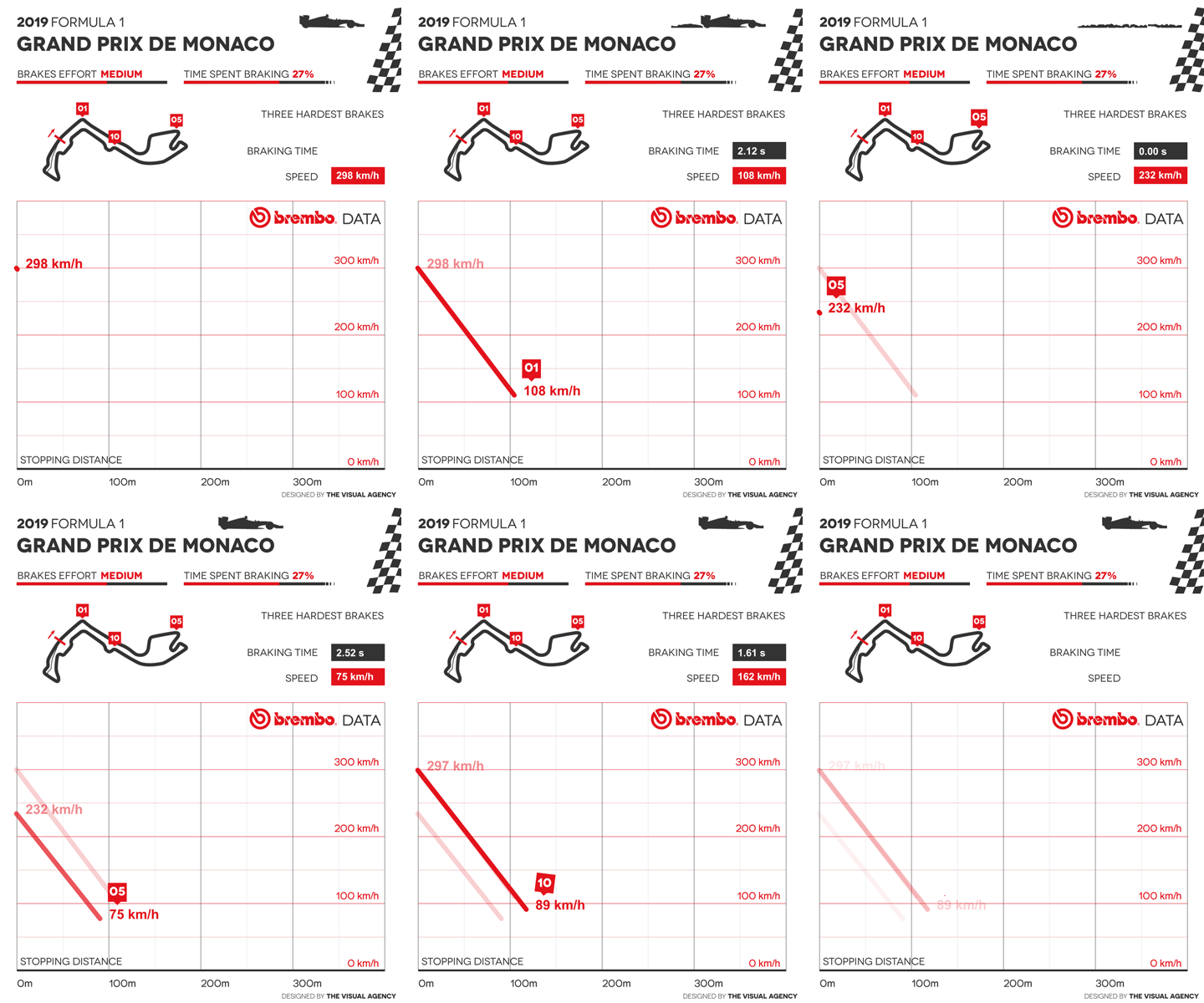
Since the stretches are not very fast, with the partial exception as the cars exit the tunnel and the Mirabeau, the braking never exceeds 2.6 seconds. And there are 5 corners where the peak deceleration doesn't even reach 3 G. That translates into an average deceleration of 3 G, which is almost 2 points lower than that registered at Montreal. The numerous braking sections means the amount of energy each car dissipates in braking over the entire course of the GP is really high: 239 kWh.
From the starting line to the checkered flag, the ___Escaped_link_6a0f2ec0c099f___ technicians forecast that each driver will apply a load of 61.5 tons on the brake pedal. In other words, the drivers will be required to apply a force of more than 600 kg (1,323 lbs) on the brake pedal every minute of the race.
The most difficult braking section is after the tunnel (turn 10): the single-seaters arrive going 297 km/h (185 mph) and brake for less than 2 and a half seconds (2.48 seconds to be precise) to decelerate to 89 km/h (55 mph): they manage to do so in just 118 meters (387 feet). At this point, the drivers undergo a deceleration of 4.5 G and have to apply a load of 144 kg (317 lbs) on the brake lever.
At Mirabeau (turn 5) on the other hand, the speed drops down from 232 km/h (144 mph) to 75 km/h (47 mph), but the single-seaters brake for 2.52 seconds and travel 91 meters (299 feet). The load on the pedal (116 kg, 256 lbs) and the deceleration (3.6 G) are lower though.
The maximum speed over all (298 km/h, 185 mph) is reached after the straightaway at the starting line, S.te Devote: the corner isn't very sharp so the cars can take it at 108 km/h (67 mph), braking for just 2.12 seconds.
Brembo performance
This track was where ___Escaped_link_6a0f2ec0c09a0___ brakes achieved their first victory in Formula 1: credit goes to Niki Lauda and the Ferrari 312T, the first to use Brembo brake discs in 1975.
Single-seaters with Brembo brakes have won 26 of the 44 Monaco GP races they took part in, including the last ten. Ayrton Senna was the winner six times at Monaco, always driving cars equipped with Brembo brakes.


 Azerbaijan Grand Prix



 I. Hadjar


 A. Antonelli

 C. Leclerc










Replies (0)
Login to reply